
Kahului Resident Records Compared
A resident lookup in Kahului draws from records kept by Maui County and Hawaiʻi agencies because Kahului is a census-designated place, not an incorporated city with one municipal clerk. Each record answers a narrow question. Maui Real Property Assessment can connect an owner name to a parcel and mailing address, while the County GIS viewer confirms the parcel's mapped location. The Bureau of Conveyances records transfers. eCourt Kōkua identifies parties in public court cases. Elections and vital records have stricter identity and eligibility rules.
| Record | What It Confirms | Where to Search | Access |
|---|---|---|---|
| Property assessment | Owner, situs, mailing, sales clues | Maui Real Property Tax | Free public search |
| Voter status | Status and election district | OLVR or Maui Elections | Identity or approved-purpose limits |
| Court docket | Party role, case, events, filings | eCourt Kōkua | Public docket; some copies cost |
| Vital records | Birth, death, marriage event | Hawaiʻi DOH | Eligibility, ID, and payment |
| Business or license | Filed role or credential status | DCCA Business Check and PVL | Public status search |
Start where the known fact is strongest. Search property records when an address or ownership question is central. Use eCourt when a case or legal event is known. Use OLVR only through its official identity route, not as an open name list. A modern birth, marriage, or death question belongs with the Department of Health and its direct-and-tangible-interest process. These distinctions keep a Kahului resident lookup precise.
Search Kahului Court Parties
eCourt Kōkua is the statewide Judiciary route for public, nonconfidential cases, including Second Circuit matters serving Maui County. Person searches require first and last names. A middle name, filing-date range, case type, and partial or phonetic control can separate spelling variants and common names. Second Circuit case IDs begin with the circuit digit 2.
| Field | Use | Identity Check |
|---|---|---|
| First and last name | Required person search | Try exact, partial, and phonetic modes |
| Middle name | Optional narrowing | Compare aliases in the party table |
| Filing dates | Optional date range | Match the expected time period |
| Case type | Limits the result class | Confirm party role and court |
The result may show case ID, status, court, filing date, party roles, aliases, events, dispositions, and docket text. A PDF icon means a document is online. Its absence does not mean the filing is absent. Older files and unscanned papers may remain with Legal Documents at Hoapili Hale.
Confirming Kahului Name Matches
A same-name result is only a lead. Hawaiʻi Judiciary warns that a name search does not guarantee positive identification. Compare the court, party role, filing date, aliases, and case type with another official source. An owner-name result in Maui Real Property Assessment should also be checked against the TMK, deed date, parcel situs, and mailing address. TMK means the tax-map key used to identify land.
- Write the full name, suffix, middle initial, spelling variants, and likely date range.
- Check the county owner roll by name and by known address or TMK.
- Run eCourt with exact, partial, and phonetic controls, then review the party role.
- Confirm the finding with a dated deed, vital index, filing, or custodian copy.
- Label the result by what it proves, such as owner, court party, or historical subscriber.
This method avoids turning a business address, owner mailing address, or old subscriber line into a claim of current residence. For a wider address search, use the Kahului directory by street.
Kahului Voter Status Access
The Hawaiʻi Online Voter Registration System verifies a person's own status through a Hawaiʻi driver license or state ID and the last four Social Security digits. Maui Elections also has a phone route using name, residence address, and date of birth. This is not an unrestricted name search. Under HRS §11-97, full name, district or precinct, and voter status form the public layer, while identifiers and most affidavit details remain confidential.
An approved election-purpose data request follows the County Elections affidavit and fee process. A resident lookup should not imply that an arbitrary visitor can download street addresses. If the official status route is unavailable, contact the County of Maui Elections Division instead of using a copied roster.
Kahului Vital Record Routes
Birth, death, marriage, civil-union, and divorce questions do not all go to the same desk. The Hawaiʻi vital-record ordering portal handles eligible certificate orders with government ID and payment. Modern certificates require a direct and tangible interest under HRS §338-18. The first copy costs $10, added copies cost $4, and an administrative charge applies. DOH says processing may take four to six weeks.
Mail orders go to the Office of Health Status Monitoring in Honolulu. In-person help is available in Honolulu, while the Maui District Health Office in Wailuku provides instructions. Since February 1, 2026, DOH no longer maintains divorce records. Maui divorce files must be requested through Second Circuit Legal Documents. Historical birth indexes for 1896 through 1909 can be consulted at Kahului Public Library, but they are indexes, not certificates.
When Kahului Court PDFs Stop
Online absence can be a cutoff, not a missing case. District civil documents filed before October 7, 2019, Circuit civil documents before October 28, 2019, Land Court and Tax Appeal documents before November 18, 2019, and Family civil documents before April 25, 2022 are not online. The refreshed 2026 portal instructions make those limits important to any current resident lookup.
Hoapili Hale public terminals provide free on-screen review. Files older than five years may be offsite, so call Legal Documents at 808-244-2969 before visiting. Forms 2D-P-330 and 2D-P-332 support specific inspection and copy requests by case number, party, document title, and plain or certified copy choice. Written requests generally take ten business days; mailed work may take fifteen to twenty.
Kahului Resident Identity Route
The official Hawaiʻi voter registration form illustrates why the voter channel is identity-controlled rather than a casual resident directory.
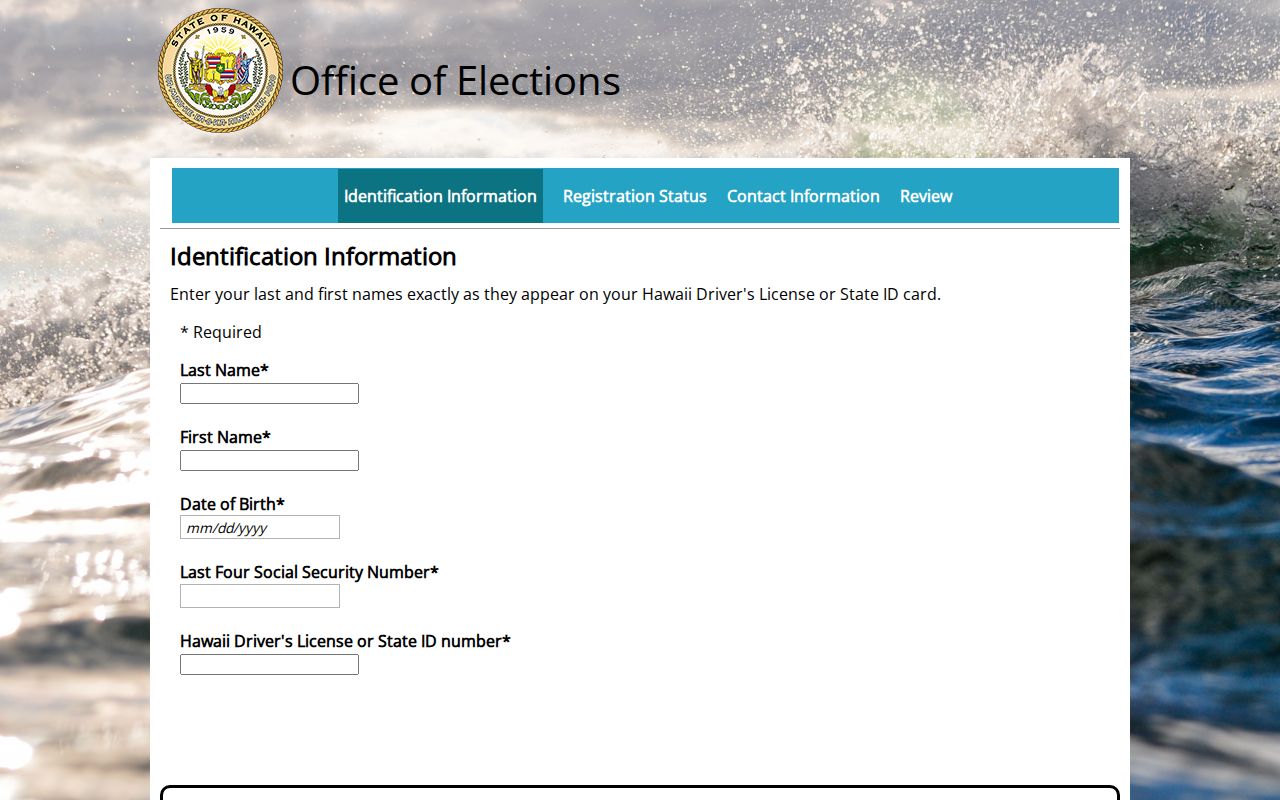
The form asks the voter to supply qualifying identity details. It supports personal status confirmation, while the separate statutory public layer remains narrow.
Tracing Kahului Heirs Carefully
For a deceased former resident, begin with a dated obituary or Maui News index entry, then search a Second Circuit probate file for the representative and estate filings. Follow any recorded transfer through the Bureau of Conveyances. FamilySearch collections can bridge older Maui probate, tax, deed, and grantor records, but an heir named in an old filing is a historical connection, not a statement of current whereabouts.
Birth-parent or adoption questions follow confidential DOH and Family Court channels. No Kahului-specific public adoption registry was found in the research. Former classmates may be traced through Kahului Public Library, yearbooks, Maui Historical Society, and newspaper sources, with each entry kept in its original date and spelling.
Verifying Kahului Resident Records
A certified copy is the custodian's authenticated version of a record. It is not the same as an index entry or a downloaded docket screen. Use the lightest source that answers the question, then order a certified copy only when formal proof is required.
- Anchor the name to a dated parcel, deed, directory entry, or authorized voter confirmation.
- Search court parties with full name, middle name, spelling controls, and a date range.
- Compare roles, dates, and places against an independent official record.
- Request the named document from its custodian if the online index lacks an image.
- Docket
- The ordered list of filings and events in a court case.
- Index vs image
- An index describes a record; an image reproduces the filed document.
- Certified copy
- A copy authenticated by the office that keeps the original.
Safe Kahului Resident Lookup
Hawaiʻi's Uniform Information Practices Act, HRS Chapter 92F, opens many government records but preserves specific privacy limits. Court home addresses, Social Security numbers, dates of birth, phone numbers, sealed cases, and juvenile material are not public search fields. Vital certificates require statutory eligibility. The Address Confidentiality Program under HRS Chapter 801G gives qualifying survivors a substitute address and mail forwarding. Never try to connect that substitute address to a protected location.
If an official record is wrong, request correction from the custodian under the process described in HRS §92F-24. Record the source and date instead of silently rewriting it. Commercial directory results may be stale or merged; they cannot replace a dated official record.
Lawful use. A Kahului resident lookup is for lawful personal research. Never use a record to stalk, harass, threaten, or expose a protected person.
Kahului Resident Lookup Fallbacks
A portal failure is not a negative finding. For an older or unavailable Second Circuit document, use the Legal Documents Branch at Hoapili Hale and provide the case ID, party name, case type, and date range. Vital certificates require the Department of Health form, identification, payment, and proof of a direct and tangible interest. Since February 1, 2026, divorce requests go to the Judiciary instead of Health.
For a County record, ask the named department first, then use MauiGovQA for a precise UIPA request if needed. Describe an existing index, permit, parcel file, or dated record rather than requesting a newly compiled list of people. Save the portal error, request date, and custodian response. This keeps a Kahului resident lookup honest when the online evidence is incomplete.