
Kahului City Directory Holdings
The main Kahului city directory run is not a city-only series. UH Library's bibliography identifies Polk's island directory covering Hawaiʻi, Maui, Kauaʻi, Lānaʻi, and Molokaʻi. It must be searched under Kahului and nearby labels. A separate Library of Congress telephone reel supplies online pages for Maui localities, while newspapers and indexes help fill the years between editions.
| Collection | Years | Where Held | Access |
|---|---|---|---|
| Polk island city directory | 1954-1987 | UH Hawaiian Collection; HMLTN microfiche D70144 | Library reference; exact volume check |
| Wailuku White and Yellow Pages reel | April 1958-1963 | Library of Congress | Free text, image and PDF online |
| The Maui News and index | Print 1900-present; index 1900-1973 | HSPLS and Maui Historical Society | Print, microfilm, index and later full text |
| Historical state collections | 1814 onward, set dependent | State Archives and FamilySearch | Online index or image; reference room |
No official catalog record for a separate Kahului reverse or criss-cross title was found. Ask reference staff for street sections, phone books, reel locality indexes, and address-to-name tools, then record the exact shelf title. Earlier Territory and Kingdom directories exist, but their catalog entries do not prove each volume has a Kahului section.
Kahului Directory Years and Labels
The cataloged title is City directory of the islands of Hawaii, Maui and Kauai, including Lanai and Molokai, also called Polk's directory of the islands. Its 1954-1987 run is the strongest located shelf spine for Kahului city directory research. Search Kahului, Wailuku, Puʻunene or Puunene, Paia, Spreckelsville, Maui County, and plantation-camp labels. Do not assume a person missing under “Kahului” is absent from the volume.
The UH Hawaiʻi biographical bibliography documents the holdings and call numbers. Its image below is a path into the catalog evidence, not a scanned household page.
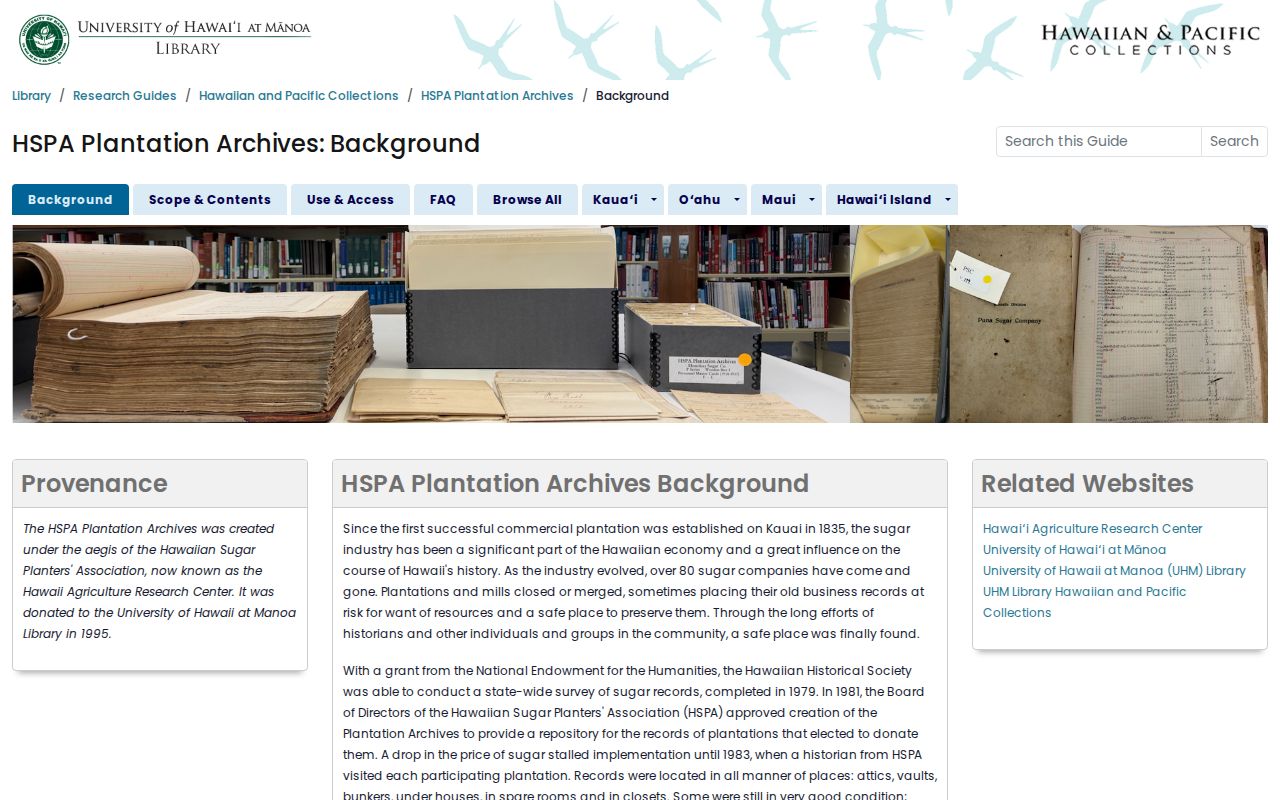
The bibliography helps staff retrieve the right volume or microfiche. Check the locality index and publication page before citing a listing.
Read Kahului Telephone Listings
The Library of Congress Wailuku telephone reel covers April 1958 through 1963. Its locality index and pages include Kahului, Puʻunene, Wailuku, businesses, agencies, and personal phone subscribers. The online viewer offers text, images, and PDF formats, which makes it the most direct digitized city directory companion found for Kahului.
Actual 1963 lines include a surname and given name, an r mark for residence, a number and street or locality, and a telephone exchange or number. White Pages and Yellow Pages are different record types. A phone entry is evidence of a subscriber listing near that date, not a full household census.
Decode a Kahului Directory Entry
Read the title page and abbreviation key before reading the name line. The inspected telephone reel supports a limited set of fields. The Polk microfiche may include more household marks, but no open official scan of its full key was found, so generic abbreviations should not be copied into a Kahului city directory citation.
| Name | Alphabetized surname and given name or initial |
|---|---|
| Entry type | Person, business, or agency line |
| Residence mark | r appears in inspected telephone listings |
| Address | Street number and name, locality, or camp label |
| Phone | Historical exchange and number |
- Criss-cross directory
- A directory arranged by address or telephone number rather than surname.
- Householder index
- A list centered on the person identified as head of a household.
- Abbreviation key
- The volume's own legend for short marks and terms. Save it with every citation.
A strong citation includes collection title, publication year, locality, page or image, line spelling, and access date. Preserve diacritics or their absence exactly as printed.
Kahului Library Opens the Shelf
The Kahului Public Library is the local reference bridge for catalogs, newspapers, genealogy databases, and staff referrals. It opened in 1963 and reopened in 2025, two useful dates when tracking institutional records. HSPLS also provides Ancestry Library Edition in branches and on public-library Wi-Fi, while HeritageQuest is available with a library card.
The official branch page pictured below is the starting point for confirming current access before a visit.
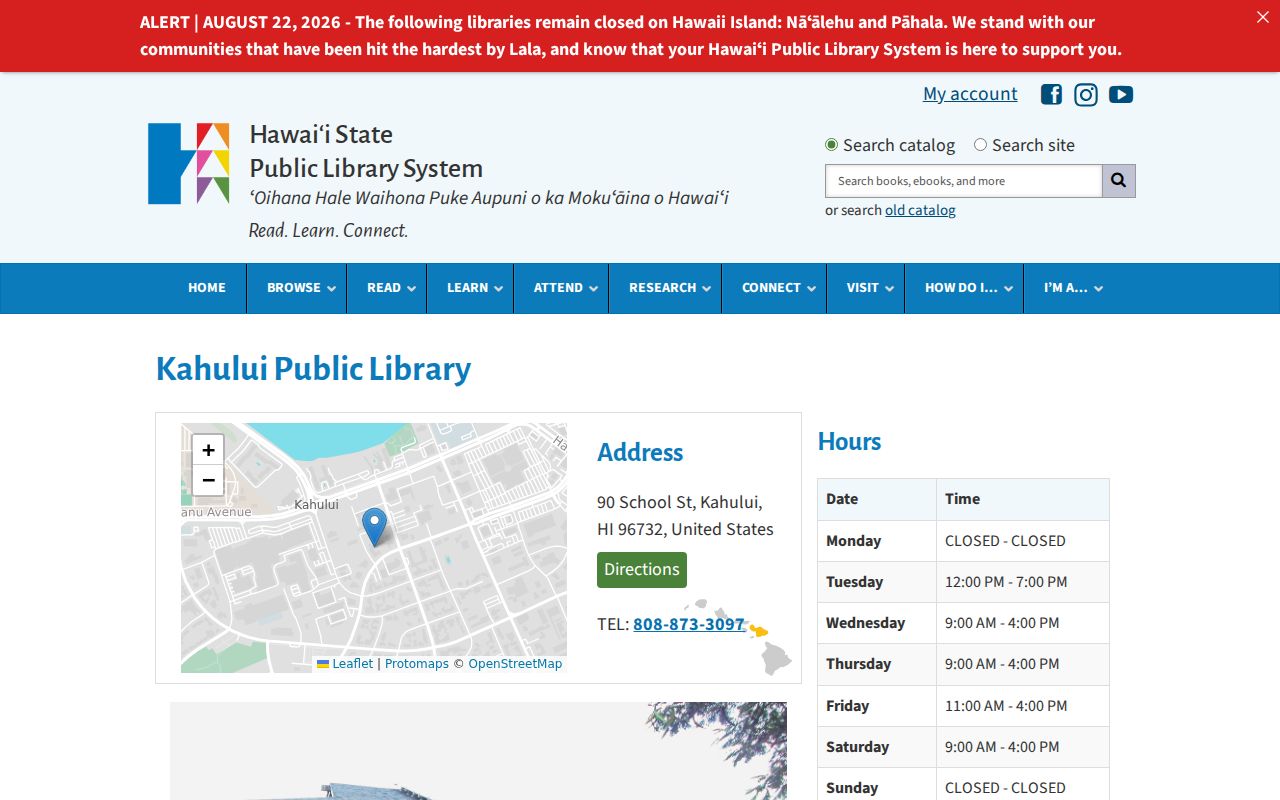
Ask for an exact volume, microfiche, newspaper date, obituary index entry, or locality heading. Staff can also route a request to the main Hawaiʻi and Pacific collections or UH holdings.
Kahului Directories Meet Newspapers
The HSPLS newspaper guide lists The Maui News in print from 1900 to the present, an index from 1900 through 1973 in three volumes, and online full text from August 29, 2004 forward. Chronicling America covers February 17, 1900 through December 29, 1922. A directory address can therefore be checked against an obituary, notice, organization item, or public event near the same year.
Record the newspaper title, issue date, page, headline, name, and locality. An obituary may be family-supplied and can contain errors. Use it as a route to probate, cemetery, church, or deed evidence, not as a substitute for those records.
Note: A directory and newspaper agree only when their dates, spelling, and locality refer to the same person rather than a namesake.
Maui Archives Beyond City Directories
Maui Historical Society archival research requires an appointment and a request form. Its finding aids describe genealogy reference material, County reports and licenses, family files, Wailuku Sugar Company papers, maps, photographs, manuscripts, and other Maui collections. Published charges are $25 for initial research and $75 for research services.
The Society's research page shown here helps a researcher prepare a precise request.
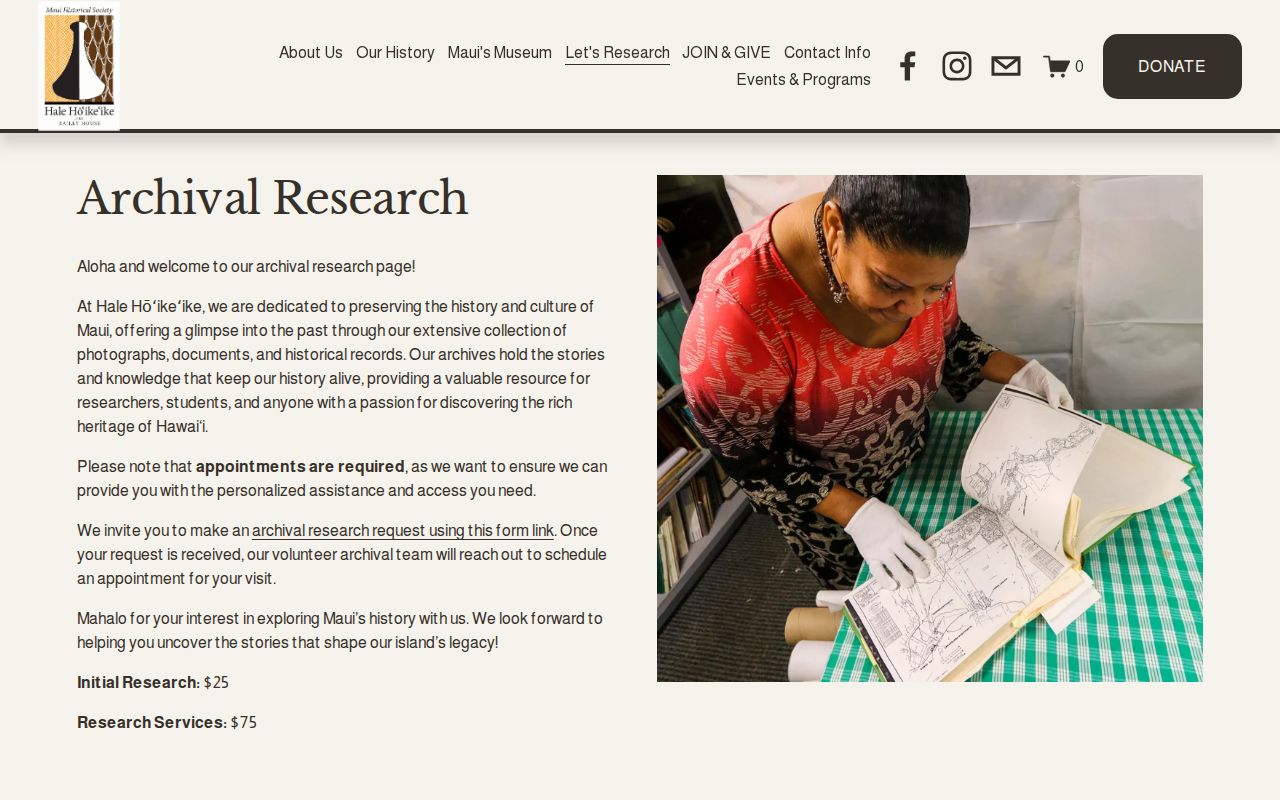
Give a surname, date span, address, and terms such as Kahului Railroad, Kahului Harbor, Dream City, plantation camp, or a named institution. A finding aid proves a collection exists, but not that each name is indexed or open.
Kahului Genealogy Index Routes
Hawaiʻi State Archives indexes include marriages from 1826-1929, divorces from 1848-1929, naturalization from 1844-1894, probates from 1848-1915, and wills from 1852-1915. The separate Hawaiʻi Digital Archives offers its own search and browse system. Neither is a single all-resident name index.
FamilySearch collections add Maui grantor and grantee indexes, deeds, probate packets, tax rolls, historical census material, obituaries, and voter applications. Always cite the original repository and collection. An online index is not the same as a certified record or a complete file.
Kahului Directory History in Context
Kahului records reflect rapid change around the harbor, rail corridor, plantation camps, and the 1947-1963 “Dream City” planning period. A compact timeline helps place each city directory source in the right setting.
| 1900 | The Maui News print run begins |
|---|---|
| 1914, 1927, 1945 | Sanborn sheets provide built-setting comparisons |
| 1946 | A tidal wave destroys much of the Kahului Railroad archive |
| 1954-1987 | Cataloged Polk island directory run |
| 1958-1963 | LOC Wailuku telephone reel span |
The 1946 archive loss is important. A missing railroad file does not prove that a person, route, or business did not exist. Check newspapers, maps, city directories, deeds, harbor reports, and Maui Historical Society files in parallel.
Trace Family Through Kahului Directories
A dated listing becomes more useful when paired with a census, newspaper, land, or probate record. Federal census schedules follow the 72-year release rule, so the 1950 census is open in 2026 while later individual schedules remain closed. Kahului's Census-place boundary, postal label, and historical district should not be treated as the same geography.
- Start with a full name, known date, address, or newspaper reference. Search initials, surname variants, and married or maiden forms separately.
- Check the closest Polk volume and the LOC telephone reel. Search each plausible Maui locality and record the year, page, and entry type.
- Compare nearby directory years. A changed address is a lead; a missing line may mean an unlisted phone, different label, move, death, or publication gap.
- Pair the listing with an open census schedule or historical Hawaiʻi census collection. Keep the source boundaries and enumeration date.
- Close the trail with The Maui News index, an obituary, probate packet, deed, cemetery directory, or State Archives index.
If an old address needs modern parcel context, the Kahului street directory workflow explains the TMK, GIS, and deed joins without treating a historical listing as current resident evidence.
Kahului City Directory Research Help
When a digital search fails, the Kahului Public Library reference desk is the first local fallback. Ask for the exact directory title, year, island coverage, and format, since Polk microfiche, telephone books, newspaper indexes, and licensed genealogy databases have different access rules. Ancestry Library Edition is tied to branch or library Wi-Fi use, while HeritageQuest uses a library card. Staff can also check whether a volume is held elsewhere in the Hawaiʻi State Public Library System.
Maui Historical Society accepts archival requests and schedules research by appointment. Its finding aids cover genealogy material, County records, photographs, maps, ledgers, and business collections. Research notes list a $25 initial charge and a $75 research-service fee. For statewide indexes, the Hawaiʻi State Archives offers online finding aids plus a reference-room route. Record the collection name, box or image reference, directory year, page, and printed spelling in every citation.
Old entries should be compared with a source from the next available year and with a separate record class. A deed, probate filing, census schedule, obituary, or tax record can show whether a similar name belongs to the same household. Do not silently modernize initials, diacritics, married names, or locality labels. Those differences are often the key to finding the next directory entry.