
Kahului Previous-Resident Sources
A backward address search works best when each source is assigned a time span and a narrow job. The current Maui County assessment is the first link, not the whole answer. It provides the Tax Map Key, or TMK, situs address, assessed owner, mailing address, and links into parcel history. The situs is the physical property address. It may differ from the address where the owner receives mail, and neither field identifies every person who lived there.
The table separates title evidence, household evidence, and building evidence. A deed names parties to a land transfer. A directory names a dated subscriber or householder. A permit names a project, owner, applicant, or contact. Those facts can overlap, but they should never be merged into one claim about occupancy.
| Source | Years It Covers | Where Held | What It Shows |
|---|---|---|---|
| BOC online records | 1976 to present | Hawaiʻi Bureau of Conveyances | Deeds, parties, dates, legal descriptions, liens, and releases |
| BOC historical system | Records date to 1845 | Honolulu reference room or written request | Older books, pages, instruments, and maps |
| RPA history books | Through 1987 | Maui Public Documents Search | Parcel ownership and field history keyed by TMK |
| Polk island directories | 1954 to 1987 | UH and library microfiche/reference | Dated names, addresses, and directory categories |
| LOC telephone reel | 1958 to 1963 | Library of Congress online | Subscribers, address or locality, phone, and business listings |
| Census schedules | 1950 and earlier are open | NARA and genealogy databases | Household members, ages, relationships, and residence |
| Sanborn references | 1914, 1927, 1945 | LOC and National Park Service research | Building footprints, street labels, uses, and physical change |
Start in the row closest to the date being studied. Then use a second kind of record to test the match. Searches for previous residents are strongest when a parcel fact, household entry, and dated event point to the same place.
Kahului Parcel History to 1987
The Maui Real Property Tax site connects a modern address to the current assessment and parcel tools. Search by location address, owner name, TMK, map, or sales mode. Copy the TMK exactly. That number remains more stable than a street label and joins the parcel to County permits, maps, and ownership material.
For older work, the Maui Public Documents Search includes Real Property Assessment field and ownership-history books through 1987, along with map-history folders and tax-map material. Search with the TMK, then record the book or document label and its date. The County warns that old or very recent files may be missing online. A blank result calls for the RPA counter, the responsible department, or a focused records request, not a conclusion that the record never existed.
Note: Preserve the assessment year because owner, value, exemption, and mailing fields can change from one annual roll to the next.
Walk Kahului Deeds Backward
The statewide Bureau of Conveyances holds Maui land records. Its online system covers recorded documents from 1976 forward, while earlier instruments require the Honolulu reference room or a written request. A backward chain follows sellers and buyers through dated instruments while checking the same parcel or legal description at every turn.
- Use the County assessment to record the present owner, situs, TMK, and legal-description pointer.
- Search the current owner as grantee, meaning the party who received title, and identify the deed that placed title in that name.
- Save the document number, recording date, grantor, system, and legal description. The grantor is the party who transferred title.
- Search that grantor as an earlier grantee. Check spouse, trust, estate, and name variants, but keep only matches tied to the same land.
- Repeat to the online cutoff. Before 1976, request a book-and-page search or use the historical index bridge before ordering the original.
- Chain of title
- The dated sequence of transfers for one piece of land.
- Legal description
- The formal lot, parcel, survey, or land description used in recorded instruments.
- Grantor and grantee
- The party giving an interest and the party receiving it.
- TMK
- Maui's Tax Map Key, the parcel number used across assessment, map, and document systems.
The BOC public-access instructions explain the online and pre-1976 routes. Purchased copies are $1 per page. The researched pre-1976 request fee is $35 per document plus a $10 processing charge. BOC does not conduct open-ended family or house research, so a name, time range, book/page, document number, or land clue saves time.
Kahului Records Before Online Deeds
Online absence before 1976 is an access limit, not proof that title is missing. FamilySearch identifies a Hawaiʻi grantor-and-grantee index for 1845 to 1916, with the Maui description covering 1845 to 1909, and deed records from 1846 to 1900. The index can supply names, deed type, sale date, and book/page. Its source is the original land-record custodian, but an index entry is still only a pointer.
Historical tax assessment rolls from 1847 to 1903 and probate packets from 1814 to 1917 can add an island, tax date, relatives, representatives, or estate facts. Spellings may vary, and some records are in Hawaiian. Compare the clue with the deed image or BOC copy before tying it to one Kahului parcel. The Hawaiʻi Digital Archives also publishes searchable historical indexes, while the State Archives reference staff handles collections that have not been digitized.
The official BOC access route is visible in the captured screen below. It helps separate a modern online search from historical research that needs a written or reference-room request.
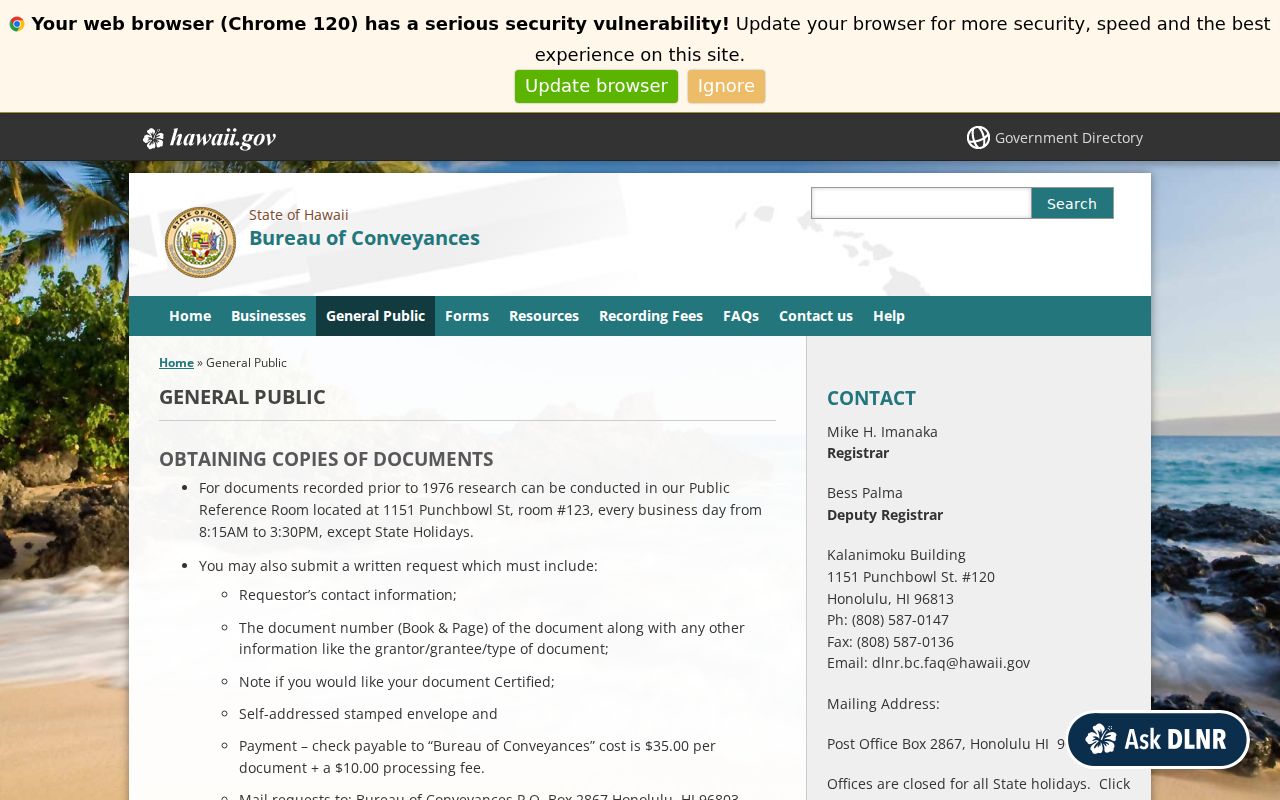
The screenshot makes the cutoff practical: use the portal for the modern chain, then carry exact names and document clues into the older request channel.
Kahului Addresses Across Three Maps
Library of Congress and HAER research cites Kahului Sanborn maps for 1914, 1927, and 1945. Comparing those dates can show a changed building footprint, street label, industrial use, or site arrangement. This is useful when an old directory address does not line up with the current parcel display. It also helps date a structure before a permit file begins.
Sanborn sheets do not name every occupant. Pair each footprint with a County tax map, deed legal description, RPA field book, and a directory or newspaper entry from the same era. An old street mismatch should be bridged through parcel geometry and land description. Research did not locate an official Kahului-wide renumbering log, so guessing a modern number from an old listing would weaken the trail.
Note: Keep the original spelling and locality label in each citation, even when a modern map uses a different Kahului address form.
Kahului Previous Household Clues
Owners and occupants are not the same. Polk's island directory run covers 1954 to 1987, and a Library of Congress Wailuku telephone reel covers 1958 through 1963 with Kahului entries. A subscriber line can connect a name to a dated address or locality. It does not prove title, a full household, or present residence. The collections and entry abbreviations are treated in depth on the Kahului city directories page.
Pair directories with open federal census schedules. The 1950 census is open in 2026, while later federal person-level schedules remain closed under the 72-year rule. For each year, record the printed address, householder or subscriber, all census household members, relationships, and the source page. Then move forward or backward one dated record at a time.
- Find the address in the closest directory or telephone reel and transcribe it exactly.
- Check the nearest open census year for the same street, locality, and household name.
- Compare names with the deed owner and tax roll, while labeling renters or subscribers separately.
- Use The Maui News index, obituary, probate, or marriage record to explain a move, death, inheritance, or name change.
Lawful use. Research past residents for house history, genealogy, heirs, or personal curiosity. Never use an address trail to watch, harass, or harm a living person.
Kahului Permits Date the Property
County permit records can place construction, alteration, subdivision, inspections, and code activity on a parcel timeline. MAPPS is the primary system for permits from April 18, 2022 forward. Public-document forms also expose issued permits, parcel information, projects, plans, field books, and map folders. Monthly building-permit reports from 2007 through 2026 were listed during research.
Search once by street address and once by TMK. Save the permit or case number, document type, project name, owner or applicant field, date, and any missing-file warning. A permit applicant is not proof of occupancy. Older files may require a phone call, department request, or a UIPA request for a specific existing document. Ask for the parcel, date range, case number, and file type rather than for a new list of everyone associated with a house.
Kahului's 1946 Archive Break
State harbor-history material reports that the 1946 tidal wave destroyed much of the Kahului Railroad's records. That loss matters for a home or parcel linked to the harbor, rail approaches, warehouse district, or plantation-era transport system. A missing railroad file may be a real archive gap rather than evidence that a person or structure had no connection to the site.
Rebuild the period from parallel sources: the 1914, 1927, and 1945 Sanborn references, harbor and general-plan reports, Maui News notices, deeds, tax rolls, directory entries, photographs, and planning maps. The method is slower but clearer because every item carries its own date and purpose. This local event is one reason previous-resident research in Kahului often needs a packet of evidence instead of one master file.
Kahului Archive Request Routes
Not all useful material is online. The Hawaiʻi State Archives research page describes reference service and finding aids for probate, wills, naturalization, marriage, divorce, maps, and government records. Its captured page below shows the research route a searcher can use after exhausting the digital index.
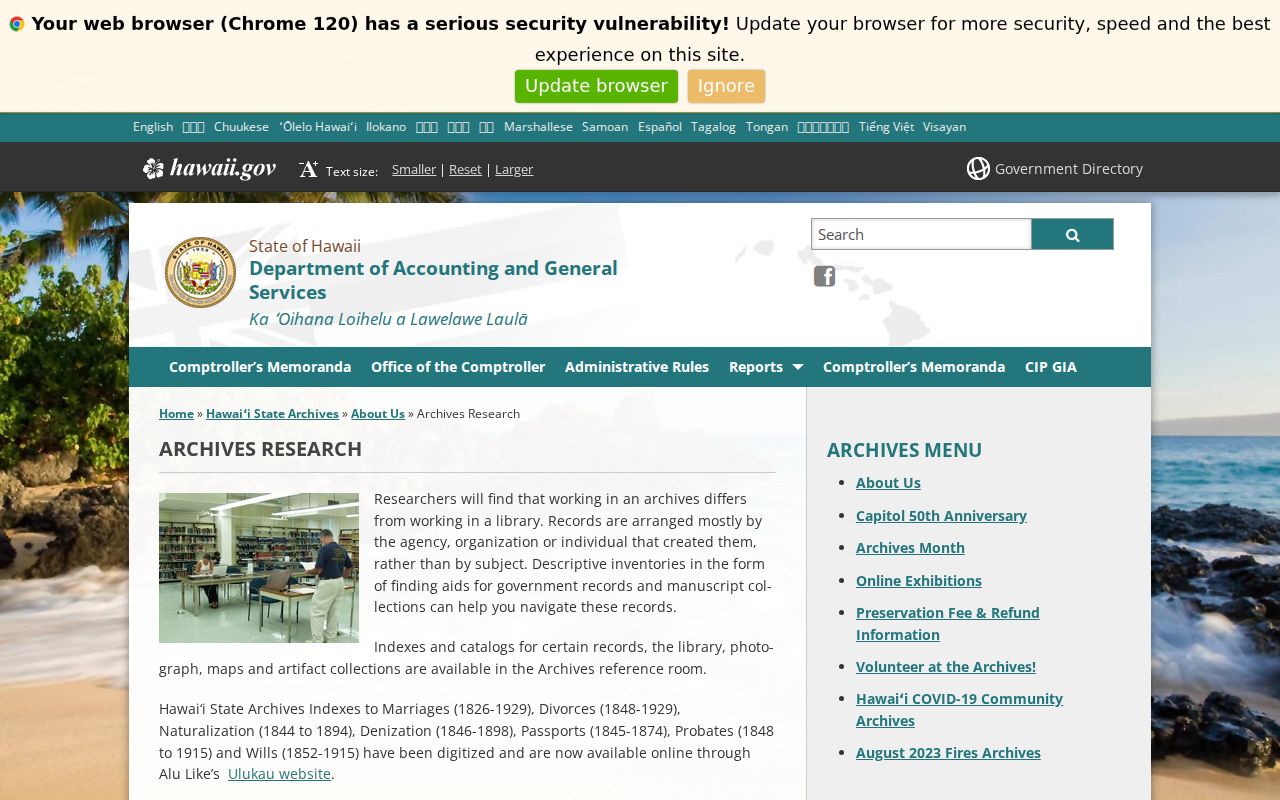
Prepare a short request with the address variants, TMK, names, year range, and record type. For Maui Historical Society, an appointment and form are required; researched charges are $25 for initial research and $75 for research service. Kahului Public Library and HSPLS can help locate newspaper runs, directory call numbers, and branch-only genealogy databases.
The Digital Archives offers another online starting point. The screen below represents the statewide historical-index route, not a complete Kahului household list.
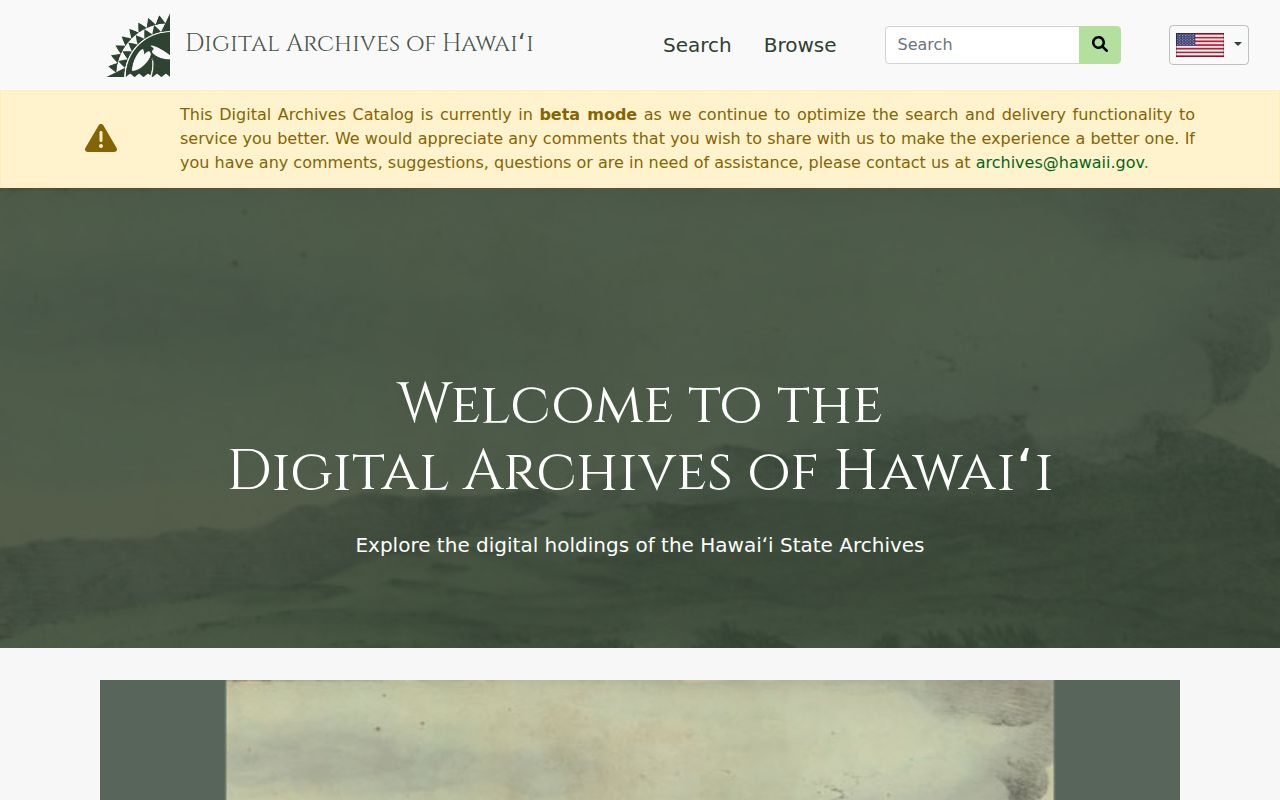
For access failures, use BOC's written pre-1976 process, an archive inquiry, a library reference request, the RPA office, or a targeted Maui County UIPA request. Together these channels keep a past-resident search moving when an image, book, or permit is not posted.